Ever bought a shirt that looked vibrant in the shop, only to find the color looked dull or completely different when you brought it home?
Lighting can dramatically change how we see fabrics, food, interior paint, and skin tones. While factors like illumination levels and color temperature play a role, one of the most useful measures of this visual difference is CRI, or Color Rendering Index.
Whether you are choosing lighting for your home, a retail space, or a new luminaire design, understanding CRI helps you make a more informed choice. This guide explains CRI ratings, the difference between 80, 90 and 95 CRI, and the specifications worth checking.

What Is CRI in Lighting?
The Color Rendering Index (CRI) is a quantitative measure that indicates how accurately a light source reveals the true colors of objects compared to a reference light source of the same color temperature.
A score of 100 indicates a match to the reference under the CRI test method. While it is commonly thought of as a 0–100 scale, CRI can actually dip into negative values for light sources with extremely poor color rendering, such as low-pressure sodium streetlights.
A higher CRI generally indicates closer average color rendering to the reference. It is important to note that high CRI is about color fidelity (faithfulness), not necessarily color saturation. A high-CRI light does not automatically make colors look more vivid; it simply renders them more faithfully to the reference source.
What Is a Good CRI Rating?
Selecting a "good" CRI rating depends entirely on the application. A utility space does not need the same color fidelity as a high-end art gallery. Here is a general guidance table for standard LED lighting:
| CRI (Ra) Range | Color Quality Level | Typical Applications |
|---|---|---|
| Below 70 | Poor | Industrial yards, outdoor roadways. |
| 70 – 79 | Standard | Basic utility spaces, standard parking garages, some warehouses. |
| 80 – 89 | Good (Baseline) | Standard commercial offices, classrooms, general retail, residential spaces. |
| 90 – 100 | Excellent | Fashion boutiques, museums, high-end hospitality, medical clinics, premium architectural lighting. |
These ranges are general selection guidelines, not universal requirements. Choose lighting according to the visual task, project specifications, and applicable standards.
80 vs 90 CRI: What Is the Difference?
A 90 CRI light generally renders colors more faithfully to its reference than an 80 CRI light. The difference may matter more when viewing clothing, food, artwork, or skin tones than in a neutral corridor.
Picture the same shirt under two lights with the same color temperature and similar brightness. An 80 CRI source and a 90 CRI source can render its colors differently, but how much that matters depends on what you are lighting.
TRY THE COMPARISON
Where would you use the light?
Choose a setting to explore what to look for.
A clothing shop or dressing area
A general-purpose starting point
Can work for general illumination, but the Ra score alone will not tell you how faithfully saturated fabrics and reds appear.
For closer color evaluation
Often preferable when customers compare fabric colors or judge an outfit. Check R9 and view real samples under the proposed lighting.
What to check: Compare the same garment under both lights at similar CCT and illumination. Look at reds, subtle shades, and skin tones.
Higher CRI indicates closer average fidelity to the reference under the test method. It does not mean brighter light or guarantee better rendering of every color. Compare R9, CCT, and product test data as well.

CRI vs CCT: Color Accuracy and Color Temperature
It is easy to confuse CRI with CCT (Correlated Color Temperature), but they measure two completely different things:
- CCT describes whether white light appears warm or cool, measured in Kelvin (K). A 2700K LED looks warm and yellowish, while a 5000K LED looks crisp and blueish-white.
- CRI describes average color fidelity relative to a reference.
A warm, 2700K LED with a high CRI has its color rendering assessed against a warm reference source; its spectrum need not match an incandescent bulb. Similarly, you can have a 4000K LED with poor color rendering (CRI 70) and a 4000K LED with excellent color rendering (CRI 95). Both have the same nominal CCT, but their tint and color rendering can still differ, affecting how objects and finishes appear.
Why CRI Matters: Practical Examples
- Retail and Apparel: In fashion, fabrics must look authentic. A low-CRI light can make deep red garments look muddy or brown. High-CRI lighting can help customers assess fabric colors more accurately. This is why many retail lighting fixtures rely on high-CRI COB LEDs, like those developed by Everstar, to maintain vibrant displays.
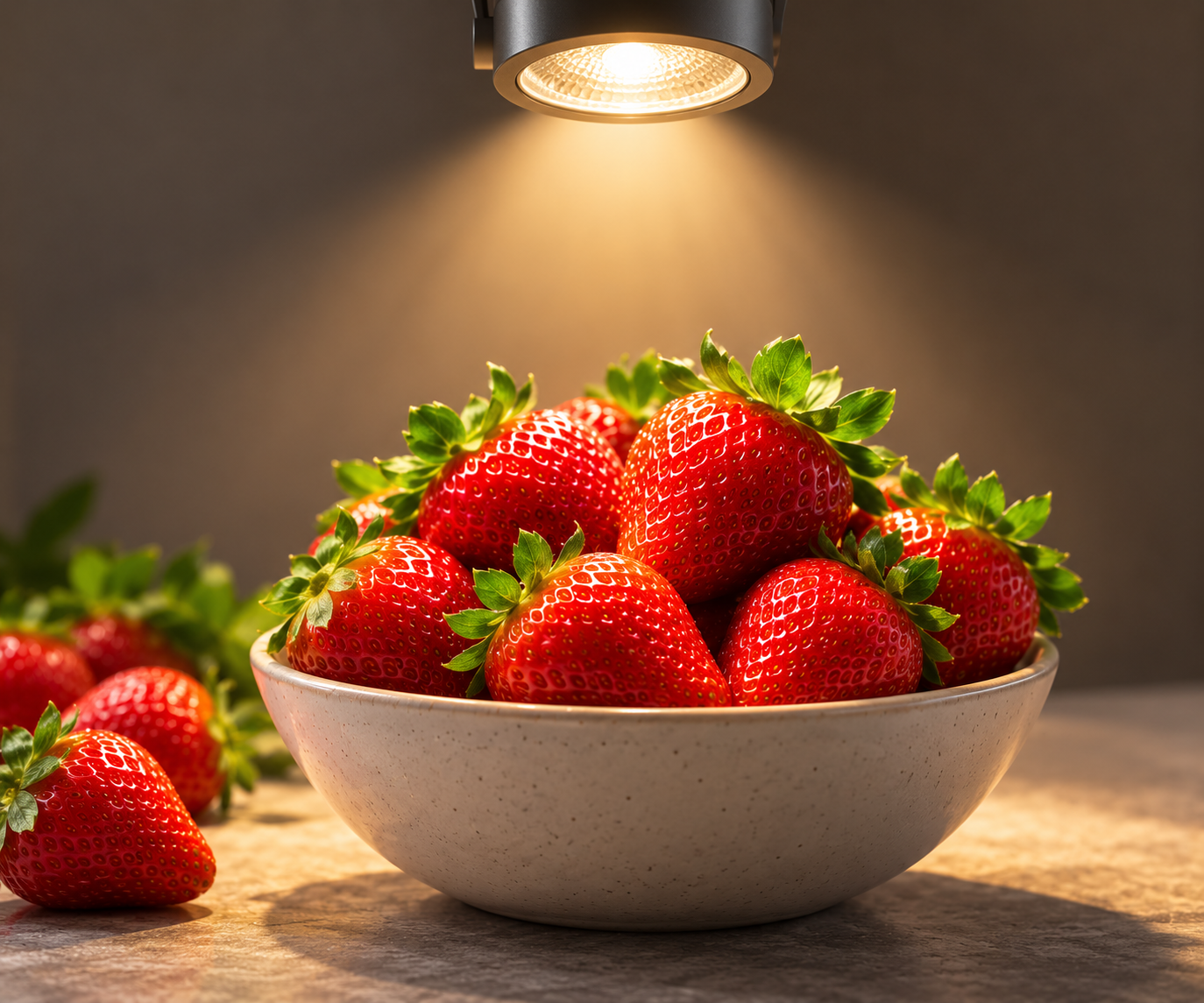
- Hospitality and Food: Restaurants rely on ambiance. High CRI lighting can help fresh produce look vibrant and appetizing, and interior finishes like mahogany or brass retain their warmth.
- Healthcare: Doctors rely on precise visual cues. High CRI lighting is specified in medical environments so practitioners can accurately assess skin conditions, blood vessels, and tissue health.
- Residential Living: At home, high-CRI lighting can make it easier to judge makeup, compare clothing colors, and appreciate artwork or interior finishes.
How Is CRI Measured and Why Does R9 Matter?
The traditional CRI measurement (referred to as Ra) calculates the average color rendering across eight standard, relatively unsaturated pastel color samples (R1 through R8).
Because Ra averages these light pastels, it does not separately capture a light source's ability to render saturated colors, most notably, deep red (R9). A light source can have a high Ra score but a low R9 score, which can contribute to less natural-looking skin tones and distorted reds. When specifying lighting for high-end retail, hospitality, or healthcare, lighting professionals should ask for both the Ra and R9 values.
Note: As the lighting industry evolves, newer and more comprehensive standards like ANSI/IES TM-30-24 are becoming popular. TM-30 evaluates color using 99 color samples and provides metrics for both Fidelity (Rf) and relative gamut area (Rg).
How to Choose the Right CRI for an LED Project
When procuring LED packages, whether you are choosing between COB and SMD LED technologies, use this practical specification checklist:
- Determine the Baseline: Do you need 80+ for general lighting or 90+ for color-critical applications?
- Check the R9 Value: If illuminating skin, food, or art, target a specific minimum R9 value (e.g., R9 > 50 as an example project target).
- Review Efficacy vs. Color: Ensure the selected high-CRI module still meets your project's lumen-per-watt (lm/W) requirements.
- Request Test Data: Ask the manufacturer for spectral data or TM-30 reports. A simple photograph or lux meter cannot establish color rendering; reputable suppliers like Everstar will provide these detailed photometric reports upon request.
- Test the Complete Luminaire: Secondary optics (lenses and reflectors) can cause slight color shifts. Always evaluate CRI in the final fixture.
Common CRI Specification Mistakes
Treating Package Names as Quality Ratings
Terms like 2835, 3030, or COB refer to the physical packaging and structure of the LED. They do not dictate color rendering. You can purchase a 2835 SMD LED in both 70 CRI and 95 CRI, which is why Everstar categorizes its SMD and COB lines strictly by verified optical performance.
Ignoring R9
Specifying a high Ra while neglecting R9 is a common pitfall in retail lighting design.
Assuming Tunable White maintains constant CRI
For OEM readers designing tunable-white fixtures, always request color-rendering data across the entire tuning range, as CRI can fluctuate as the color temperature shifts.
FAQs
What does CRI mean in LED lighting?
CRI (Color Rendering Index) is a metric that evaluates how accurately an LED light source reveals the colors of objects compared to a reference light source.
Is 80 CRI good enough?
Yes, 80 CRI is a common baseline for many general indoor applications, including office spaces, classrooms, and basic retail.
Is 90 CRI noticeably better than 80?
It depends on what you are illuminating. The difference can be more noticeable on rich wood tones, human skin, colorful artwork, and fresh food. It is less noticeable in a neutral grey-and-white office corridor.
Can warm-white LEDs have high CRI?
Absolutely. Color temperature (warm or cool) is separate from color rendering. You can easily source high-CRI LEDs in very warm color temperatures like 2700K or 3000K.
Does high CRI mean brighter light?
No. CRI describes color rendering, while lumen output describes the amount of light produced. High-CRI LEDs can have lower luminous efficacy than comparable lower-CRI LEDs, but actual performance depends on the product. Compare lumen output and lm/W under similar test conditions.
Can two LEDs with the same CRI look different?
Yes. Because general CRI (Ra) is an average of eight color samples, two LEDs can have the exact same Ra score but render saturated colors (like deep reds, measured by R9) very differently. Additionally, variations in tint or spectrum can make them look distinct.
Where can I find an LED’s CRI and R9 ratings?
Start by checking the product packaging, specification pages, or datasheets. For professional projects, request detailed colorimetric test reports (such as an integrating sphere report) from your LED manufacturer.
Partner with Everstar for Your Next Lighting Project
Everstar offers COB and SMD LED packages for a range of lighting applications. When selecting a component, check the model’s CRI, CCT, lumen output, and efficacy. Contact Everstar to confirm available options and request color-rendering data relevant to your project.
Contact us at www.everstar.in.
Discuss Your Lighting Project